
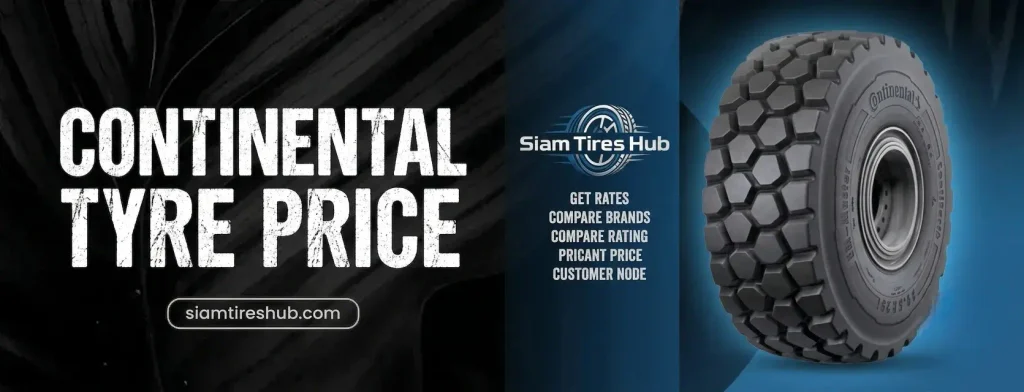
Continental Tyre Price: What Determines Value in Heavy-Duty Applications?
Choosing tyres for commercial and industrial vehicles is rarely just about finding the lowest price. Tyres influence operating costs, vehicle performance, downtime, load handling, and maintenance requirements. Therefore, understanding what shapes Continental tyre price can help buyers make more informed purchasing decisions. For truck fleets, construction equipment, logistics operations, and industrial machinery, tyre selection becomes even more important. A tyre may have a higher initial cost but offer better suitability for its intended application. Furthermore, price can vary according to tyre size, construction, load rating, application, and product specification. These factors matter because heavy-duty tyres are designed for demanding working environments. This makes the relationship between price and value worth examining before making a commercial purchase. Why tyre pricing varies across applications? Tyres are engineered for different operating conditions. A road-going truck does not face the same demands as a mining loader or port vehicle. Truck and bus radial tyres, for example, are designed around commercial road applications. OTR tyres, meanwhile, are intended for equipment working on demanding surfaces and in industrial environments. Consequently, tyre pricing reflects more than the rubber itself. Construction, size, load capacity, tread design, and intended use all contribute to the overall value of a tyre. A fleet operator should therefore compare tyres within the same application category rather than judging products solely by their listed price. What influences Continental tyre price? Several practical factors can affect the price of a commercial tyre. Understanding these factors makes price comparisons more meaningful. Tyre size and specification Tyre dimensions have a direct influence on pricing. Commercial and industrial tyres are available in numerous sizes, each developed for particular vehicles and operating requirements. For example, the products listed by Siam Tires Hub include sizes such as 10.00R20, 11R22.5, 12.00R20, 275/70R22.5, 315/80R22.5, 385/65R22.5, and 425/65R22.5. These specifications are not interchangeable. The correct size must match the equipment and its operating requirements. Load and performance requirements Load ratings also matter when assessing tyre value. Heavy-duty applications can place substantial stress on tyres, particularly when equipment regularly carries heavy loads. A tyre’s specification should therefore be considered alongside the vehicle or machine’s operating requirements. Paying more for a suitable specification can be more economical than selecting an unsuitable tyre simply because it costs less initially. Application and working environment Road transport, construction, mining, ports, and industrial facilities create different tyre demands. A construction machine may operate over rough surfaces, while a logistics vehicle may spend most of its working life on paved roads. Similarly, port equipment can face repeated heavy-duty movements and demanding operating cycles. This is why Continental tyres are available for a range of commercial and industrial applications, with product specifications tailored to specific uses. How product design affects overall tyre value? Price becomes easier to evaluate when buyers consider what a tyre is designed to accomplish. For example, the product range presented by Siam Tires Hub includes Continental models such as EcoPlus HD3, ContainerMaster, EM-Master E3, ScoopMaster L-5S, Conti Hybrid HS3, HCS, and HAC 3. These products belong to different application categories. Some are listed as truck and bus radial tyres, while others are classified as off-the-road tyres. That distinction is important. A tyre intended for container handling equipment should not be evaluated in exactly the same way as a tyre intended for long-distance commercial transport. Construction matters beyond the initial purchase Tyre construction affects how a product performs under its intended operating conditions. Buyers should consider durability requirements, expected workload, terrain, and equipment type before comparing prices. Furthermore, the cost of an unsuitable tyre can extend beyond the purchase itself. Frequent replacement, operational interruptions, and maintenance requirements can affect the total cost of running equipment. This is where Continental tires Thailand buyers can benefit from evaluating specifications alongside commercial pricing rather than treating the price tag as the only deciding factor. The role of tyre availability in commercial purchasing For businesses operating fleets or heavy equipment, availability can be nearly as important as price. A competitively priced tyre provides limited value if it cannot be sourced when required. Delays can affect vehicle availability and, consequently, business operations. Siam Tires Hub states that it maintains 12 strategically placed warehouses across Thailand and Europe. Its stated objective is to support large inventory and quicker delivery for domestic orders. For international buyers, access to inventory can also make procurement more predictable. This is particularly relevant for businesses that require replacement tyres across multiple vehicles or equipment units. Comparing brands without focusing only on price Brand comparison can be useful, but it should be based on application and specification. For instance, Kumho Ecsta tires may appear in discussions involving commercial tyre purchasing, while Kumho tyres may be considered alongside other established brands. However, a meaningful comparison requires more than comparing brand names or advertised prices. Buyers should look at the specific tyre model, size, application, load specification, and intended operating environment. The same principle applies when evaluating the Continental tyre price for a particular commercial or industrial requirement. A direct comparison is only useful when the products serve comparable purposes. When can a higher price represent better value? A lower purchase price does not automatically mean lower operating costs. For heavy-duty users, tyre performance can influence how often replacements are required and how reliably equipment remains available. This is especially significant in mining, construction, logistics, and other industries where downtime can disrupt scheduled work. A suitable tyre can provide value through its alignment with the application. The focus should therefore shift from “How much does the tyre cost?” to “What value does this specification provide for this operation?” This broader perspective makes Continental tyre price a more useful commercial consideration rather than an isolated number. Sustainability and longer tyre use Environmental considerations are also becoming relevant to industrial tyre purchasing. Siam Tires Hub has introduced the GRÜNLOAD remold loader tyre series as part of its focus on eco-friendly projects. The series uses retreading technology and emphasises material reuse and longer tyre life. Retreading can provide another perspective on tyre value because